Venetian Boat Song, Op. 19 No. 6
A Venetian gondola ride in A minor.
Mendelssohn published his first book of Songs Without Words (Lieder ohne Worte) in 1832 as Op. 19, a collection of six short character pieces for solo piano in which a singing melodic line rides above an accompaniment - no words, just the mood that words would carry. Op. 19 No. 6, subtitled 'Venetian Boat-Song', is the earliest of his three gondola songs and established a template he would return to twice in later volumes.
The piece unfolds in A minor with a lilting 6/8 metre that mimics the gentle sway of a gondola on the Grand Canal. A simple arpeggiated left-hand figure keeps the motion constant while the right hand sings a long, expressive line above it. Mendelssohn never visited Venice when he wrote it; the Italian atmosphere came from imagination and from the Romantic era's fascination with the image of the lone gondolier in the fading Venetian light.
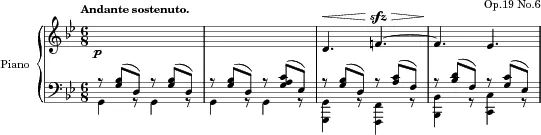
Sing first, then add the rocking motion.
Learn the right-hand melody alone, shaping each phrase as if humming it, before adding the left-hand barcarolle pattern. Once both hands are comfortable separately, focus on keeping the left-hand eighth notes even and quiet so the melody floats above without competition. Use the loop tool to isolate the central minor-mode sequence where the harmony darkens briefly before returning to the main theme.
Engraving based on the Mutopia Project edition , licensed Creative Commons Attribution 3.0.
MIDI based on the Mutopia Project edition , licensed Creative Commons Attribution 3.0.
Before you practice.
01 What is a barcarolle, and how does it apply to this piece?
A barcarolle is a genre modelled on the songs of Venetian gondoliers, written in 6/8 with a gentle lilting rhythm that suggests the motion of a boat on water. Mendelssohn's Op. 19 No. 6 is one of the most famous piano examples of the form.
02 Is the Venetian Boat Song Op. 19 No. 6 suitable for late beginners?
Yes, with patient slow practice. The 6/8 rhythm and the coordination of a singing melody over a rocking accompaniment pattern are the main challenges - both resolve well with deliberate section-by-section practice.
03 How many measures is the Venetian Boat Song Op. 19 No. 6?
The piece runs 46 measures in 6/8 time - a comfortable length that fits a typical practice session without feeling overwhelming.
Keep the gondola steady.
The 6/8 pulse must feel like one large beat per measure, not six small ones. Practice the left hand at 60% tempo, listening for uniform weight across each arpeggio. When combining hands, let the melody notes ring slightly longer than written - a touch of rubato on phrase endings matches Mendelssohn's expressive intent without disrupting the underlying sway.