Impromptu in G-flat major
About this arrangement
Schubert wrote the four Impromptus, D. 899, in 1827, the year before he died; the title came from his Viennese publisher, Tobias Haslinger. The third was not printed until 1857, and then transposed to G major because the publisher thought six flats too hard for players.
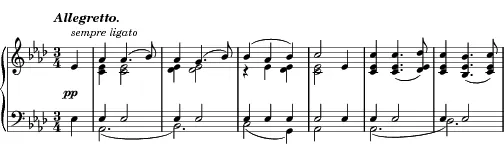
The right hand does two jobs: the melody on top with the outer fingers, the triplets underneath with the rest. Practise the triplets alone until they are soft and even, then the melody alone, then together. The six flats lie well under the hand once you stop reading them as accidentals.

Start with short loops.
Use the section list as a practice map. Start at 50% tempo, loop one section, then return to the full piece once the hand shape feels stable.
Choose Right or Left to focus on one hand. Wait for note checks the highlighted notes as you play them on the screen or a connected MIDI keyboard.
Before you practice.
01 Is Schubert's Impromptu in G-flat hard?
It is advanced. The notes are not fast, but one hand must sing the melody and play the accompaniment at the same time.
02 Why is it sometimes printed in G major?
The first edition of 1857 transposed it to G major. Schubert wrote it in G-flat major.
03 What key is it in?
G-flat major, with six flats.