Interactive piano piece
Learn Nocturne in D-flat major, Op. 27 No. 2
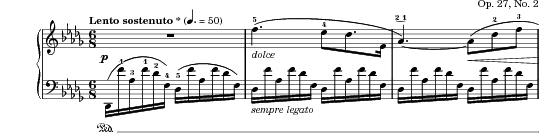
A 77-bar nocturne in D-flat major where two voices - right and left hand - gradually draw closer together in one of the most tender and intimate dialogues in all of Chopin's piano music. The interactive score and tempo slider let you live inside the long, ornamented melodic lines of this D-flat major nocturne - use the section loops to work through each phrase at a pace that lets the ornaments sing.
Browser MIDI check pending
Loading score...
Press Play for the full piece, or choose Opening and switch to Wait for note for guided right-hand practice.
About the piece
The nocturne that made Chopin's salon audiences fall silent.
The two Nocturnes of Op. 27, published in 1835 and dedicated to Countess d'Apponyi, mark the peak of Chopin's early nocturne style. The second, in D-flat major, is among the most beloved pieces he wrote: a long, ornately decorated melody in 12/8 flows over a gently rocking accompaniment, embellished with trills and turns that evolve with each repetition of the theme, growing more elaborate and more impassioned as the piece progresses.
Chopin performed it frequently in the intimate Paris salons where he built his reputation as both composer and pianist. Unlike Liszt, who courted large concert halls, Chopin preferred audiences of thirty or forty people gathered around a single candle; Op. 27 No. 2 was written for exactly that intimacy. The closing bars, with their parallel sixths in both hands ascending to a final D-flat major chord, were reported to silence rooms completely.
Practice path
Learn the skeleton before adding the ornaments.
Play through the melody removing all trills and turns first - just the main notes. Once the phrase shapes and dynamics are learned in their simplest form, add the ornaments one at a time, listening for each one to sound like a natural flowering of the melody rather than an interruption of it.
Score basis: Generated MusicXML from Mutopia MIDI. Public domain composition; Creative Commons Attribution-ShareAlike 3.0; MusicXML generated for Pianodemy. Attribution: Mutopia Project (https://www.mutopiaproject.org/ftp/ChopinFF/O27/chopin-nocturne-8/).
MIDI source: Mutopia Project (https://www.mutopiaproject.org/ftp/ChopinFF/O27/chopin-nocturne-8/). Creative Commons Attribution-ShareAlike 3.0.
Questions
Before you practice.
Short answers for learners and for searchers deciding whether this is the right version to start with.
01What makes Chopin's Nocturne Op. 27 No. 2 special?
Its two-voice texture is unique: rather than a singing right-hand melody over an arpeggio accompaniment (the standard nocturne formula), Chopin writes two independent melodic lines that develop separately and gradually converge, creating a rare sense of emotional dialogue.
02Is the Nocturne Op. 27 No. 2 harder than the Op. 9 nocturnes?
Generally yes. The two-voice counterpoint demands more hand independence than the accompaniment-plus-melody texture of most Op. 9 nocturnes, and the long phrase arcs in D-flat major (a key with five flats) require sustained tonal control across the full 77 bars.
How to use this V1
The ornaments must feel inevitable, not decorative.
At 50% tempo, play the skeleton melody and shape the phrases with a singing tone - no ornaments yet. At 70%, add one ornament per phrase and use wait-for-note mode to ensure the decorated note arrives in time. The parallel sixths in the closing bars should be played with even weight in both hands; loop them at 80% until they balance naturally before moving to full tempo.
Keep going