Interactive piano piece
Learn Clair de Lune
A luminous Debussy favorite for tone, pedaling, and patient voicing. A scrolling interactive score, slow-tempo playback, section looping, a clickable on-screen piano, and wait-for-note mode turn this page into a real practice desk rather than a static PDF.
Browser MIDI check pending
Loading score...
Press Play for the full piece, or choose Opening and switch to Wait for note for guided right-hand practice.
About the piece
Light on water, written in a drawer for fifteen years.
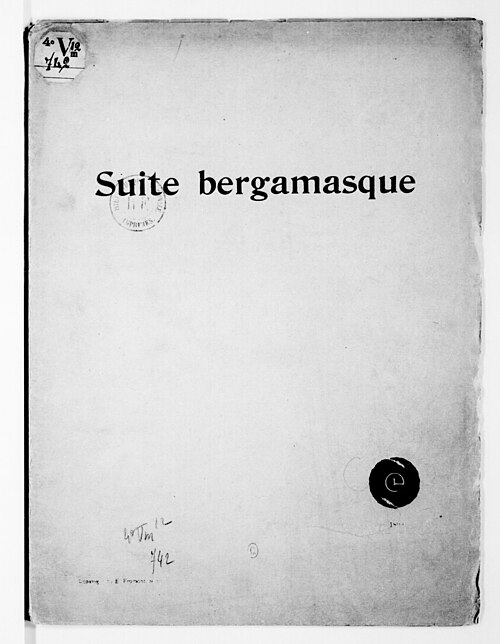
Debussy composed the Suite bergamasque, the four-movement set that contains 'Clair de lune', in 1890 when he was twenty-seven. He then left it unpublished for nearly fifteen years. By the time the Fromont edition appeared in 1905, his style had already moved on to the ocean waves of 'La mer', and he seems to have regarded the suite with a certain distance. The third movement - the one the world would come to know simply as 'Clair de lune' - had quietly become the most beloved piano piece he ever wrote.
The title is borrowed from Paul Verlaine's poem of the same name, published in 1869. Verlaine's verse speaks of souls who dance beneath the moonlight while wearing masks, melancholy beneath a surface of joy. Debussy had set Verlaine's poetry to song before, and the correspondence between the poem's emotional ambiguity and the music's shifting harmonies is not accidental. The piece moves through D-flat major but never settles: inner voices shimmer, the bass rises in unexpected places, and the final pages wash into a kind of stillness that sounds more like evaporation than resolution.
The name 'bergamasque' in the suite's title carries its own irony. The bergamask was a rustic comic dance from Bergamo, hardly the atmosphere Debussy invokes. Some scholars read the choice as a playful distance - a refined composer hiding genuine feeling behind an old-fashioned label. Whatever the intent, 'Clair de lune' transcended both the suite and its composer's ambivalence to become one of the most-played pieces in the entire piano canon.
Practice path
Four distinct sections, each with its own feel.
The piece divides naturally into four parts: the opening arpeggiated theme in D-flat major (Andante très expressif), a more animated middle section in C-sharp minor with triplet figuration, a recapitulation of the opening theme with added inner voices, and the luminous coda where the right hand traces a high melody over quiet arpeggios. Learning each section separately before connecting them gives the hands time to absorb the wide stretches and the dynamic contrasts - from the pp opening to the brief ff climax and back to ppp.
Pedaling is essential and specific: Debussy's markings ask for longer sustain than classical practice would allow, creating the characteristic blurred shimmer. Let the harmonies overlap slightly rather than changing pedal on every beat. Rubato belongs here too - the tempo marking is 'expressif', not metronomic. Push slightly into the peak of each phrase and release time on the way back down. The hands-separate work pays off in the middle section, where the right-hand triplets must float above a steady left-hand accompaniment without rushing.
Score basis: Generated MusicXML from Mutopia MIDI. Public domain source; prototype MusicXML generated for Pianodemy. Attribution: Mutopia Project, Mutopia-2010/12/21-1778, E. Fromont (1905).
MIDI source: Mutopia Project, Mutopia-2010/12/21-1778. Public domain / Mutopia distribution.
How to use this V1
Start at 50% and let the arpeggios breathe.
Use 50% tempo for the opening arpeggiated figures until each hand position feels natural, then move to 75% to check that the phrasing shapes correctly. Loop the middle section triplets separately - they tend to rush - before joining them to the opening. Wait-for-note mode is useful for the right-hand melody in the recapitulation, where the notes sit high on the keyboard and the target pitches are easy to lose at speed.
Keep going