Interactive piano piece
Learn Prelude Op. 28 No. 20 "Funeral March"
Thirteen bars of slow, crushing chords in C minor that compress a world of dynamics and voicing into the shortest possible space. A mere 13 bars of funeral gravity - slow playback and section looping let you shape every chord voicing and dynamic arc before committing to memory.
Browser MIDI check pending
Loading score...
Press Play for the full piece, or choose Opening and switch to Wait for note for guided right-hand practice.
About the piece
Thirteen bars. A hundred variations. One question.
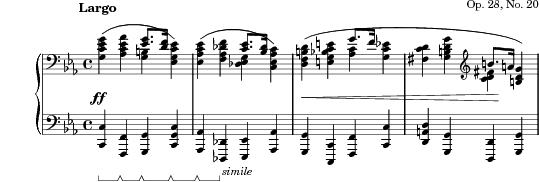
Prelude No. 20 in C minor is the most radical compression in the Op. 28 set: thirteen bars of slow, homophonic chords, marked fortissimo at the opening and decrescendo to pianissimo by the end. No melody, no counterpoint, no development - just a sequence of four-voice chords moving through the C minor harmonic world and dissolving into silence. Chopin wrote it as part of the set completed in Majorca in 1839, and of all 24 preludes it has attracted the most independent creative attention.
Sergei Rachmaninoff used it as the theme for his Variations on a Theme of Chopin, Op. 22 (1903). Ferruccio Busoni transcribed it. Countless later composers quoted it. The prelude's power lies in what it withholds: there is nothing to hide behind. Every note is exposed, every chord must be weighted correctly, every dynamic shift must be intentional. Chopin's instruction 'Largo' is the slowest marking in the entire Op. 28 set, and the correct tempo is slow enough to feel the weight of each chord before releasing it.
Practice path
Chord voicing, dynamic arc, then and only then tempo.
The piece is short enough to work through in its entirety in a single session, which is both its advantage and its trap. The danger is playing through it repeatedly without addressing the chord balance: in four-voice chords, the soprano (top note) should lead at a slightly higher dynamic, the bass should ground, and the inner voices should fill without pushing forward. Practice each chord in isolation - play it, listen to the decay, adjust the finger pressure, play it again.
The dynamic arc from fortissimo to pianissimo is the structure of the entire piece. Map it before playing through: which bar is the loudest? Which is the quietest? When exactly does the turn happen? Having a conscious dynamic plan prevents the all-too-common outcome of playing it uniformly mezzo-forte throughout.
Score basis: Generated MusicXML from Mutopia MIDI. Public domain composition; Public Domain (CC0) - Mutopia; MusicXML generated for Pianodemy. Attribution: Mutopia Project (https://www.mutopiaproject.org/cgibin/piece-info.cgi?id=472).
MIDI source: Mutopia Project (https://www.mutopiaproject.org/cgibin/piece-info.cgi?id=472). Public Domain (CC0) - Mutopia.
Questions
Before you practice.
Short answers for learners and for searchers deciding whether this is the right version to start with.
01Why is Chopin Prelude Op. 28 No. 20 called the Funeral March prelude?
The nickname comes from its slow tempo marking, heavy chordal texture, and grave C minor mood - though Chopin himself never gave it that title. It is a listener-assigned association that stuck.
02How difficult is Op. 28 No. 20 compared to other Chopin preludes?
It is one of the most accessible in the set. There are no rapid passages or complex ornaments - the challenge is purely expressive: controlling dynamics across thick chords and sustaining the slow pulse without rushing.
03What should I listen for when practicing this prelude?
Listen to the top note of each chord as a singing melody and keep the inner voices clearly softer. The crescendo and decrescendo markings are the piece's main expressive event, so practice them deliberately.
How to use this V1
Plan the dynamics before you play a single note.
Write out or sing the dynamic level of each bar before touching the keyboard. Then play at 50% tempo with exaggerated dynamics - louder at the opening and softer at the end than you think is correct - to train the hands to commit to the gradient. At full tempo, the dynamics will feel natural rather than forced. Pedaling: change every two beats to avoid harmonic blur while still allowing the slow chords to resonate. Wait-for-note mode is useful for the bars where the inner voices tend to arrive unevenly.
Keep going