Sonata KV 331 - Variation I
How Mozart starts to vary - sixteenth-note motion over the same harmony.
The first of six variations on the KV 331 theme introduces the simplest classical variation technique: the melody of the theme is embellished with faster note values - primarily sixteenth notes - while the harmony remains essentially unchanged. The right hand decorates; the left hand anchors. This is the 'figuration variation,' the building block from which Mozart will construct the more complex variations that follow.
Understanding Variation I as a deliberate pedagogical step illuminates the whole movement: Mozart shows the listener how variation works before making it more surprising. The technique was well established by 1783 - Haydn and C.P.E. Bach both used it - but Mozart's figuration is always singable, always connected to the original melody even as it moves twice as fast.
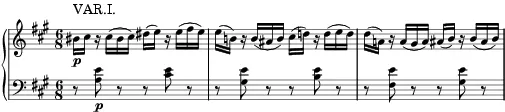
See the original theme inside the variation.
Before practising Variation I, play the Tema slowly and sing the melody. Then play the variation at 50% tempo and identify which sixteenth notes are the 'real' melody notes and which are passing ornaments. Once you can see the skeleton inside the decoration, the passagework has direction and the phrase shapes emerge naturally.
Before you practice.
01 Do I need to learn the theme before Variation I?
Yes - the theme and Variation I share the same harmonic structure. Knowing the theme lets you hear how the sixteenth-note runs elaborate the original melody, which makes both pieces easier to memorise.
02 How long is Mozart KV 331 Variation I?
Like the theme, each variation repeats its two sections, giving about 36 bars in total. At a moderate Andante tempo it lasts roughly one to two minutes.
The skeleton notes must sing louder than the passing notes.
At 50% tempo, play the right hand alone and highlight the first note of each beat with a slight emphasis - these are the melody notes from the Tema. At 80%, even out the passagework so the melody notes are only slightly louder rather than accented. Use wait-for-note mode at the join between repeated sections to keep the 6/8 lilt intact.