Interactive piano piece
Learn Sinfonia No. 4 in D minor, BWV 790
Twenty-three bars of chromatically inflected D minor - the most harmonically rich of the opening sinfonias. Use the tempo slider to follow the stretto passages - places where the voices overlap before the previous entry has finished - that make this D-minor Sinfonia particularly demanding and rewarding.
Browser MIDI check pending
Loading score...
Press Play for the full piece, or choose Opening and switch to Wait for note for guided right-hand practice.
About the piece
Stretto and urgency - D minor pressed to its limits.
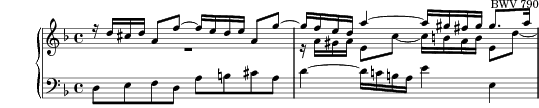
Sinfonia No. 4 in D minor is one of the more technically demanding pieces in the set, featuring stretto passages - imitative entries that overlap before the preceding voice has completed the subject. This compression of the imitative entries creates a sense of harmonic and rhythmic urgency that goes beyond the simpler imitation of the earlier Sinfonias, and it places precise coordination demands on the player that no amount of slow practice fully removes.
Bach used stretto as a compositional marker of sophistication: it appears in the most complex movements of his major fugues. Finding it here in a teaching piece speaks to how high his expectations were for advanced students - by the time a keyboard player reached the later Sinfonias, Bach expected genuine polyphonic thinking at the keyboard, not just coordination of independent hands.
Practice path
Isolate each stretto pair before combining all three voices.
Find every stretto pair - any place where a new subject entry begins before the previous one ends - and practice just those two voices together at 60% tempo. When the pair is clean, add the third voice. Do not attempt full-tempo stretto passages until each pair sounds unambiguous and balanced.
Score basis: Generated MusicXML from Mutopia MIDI. Public domain composition; Public Domain (CC0) - Mutopia; MusicXML generated for Pianodemy. Attribution: Mutopia Project (https://www.mutopiaproject.org/cgibin/piece-info.cgi?id=172).
MIDI source: Mutopia Project (https://www.mutopiaproject.org/cgibin/piece-info.cgi?id=172). Public Domain (CC0) - Mutopia.
Questions
Before you practice.
Short answers for learners and for searchers deciding whether this is the right version to start with.
01Why does Sinfonia No. 4 sound more complex than the first three sinfonias?
BWV 790 uses more chromatic notes and suspensions than the C major and D major sinfonias, creating more dissonance that needs careful resolution. The writing is still contrapuntal, but the harmonic palette is wider.
02How long is Bach's Sinfonia No. 4 in D minor?
23 bars, making it one of the shorter sinfonias. Despite its brevity, the chromatic writing means there is a lot of harmonic detail to absorb and project in a short time.
How to use this V1
Count carefully through the overlapping entries.
The stretto passages are deceptively easy to mis-count: the overlapping entries mean your two hands are at different points in the subject simultaneously. Use the interactive score to visually confirm where each voice stands at every beat, then play at 65% tempo with a metronome until the entries lock in precisely.
Keep going