Interactive piano piece
Learn WTC I Prelude in G major, BWV 860
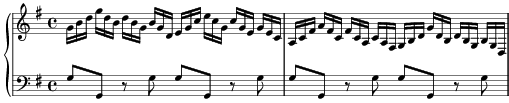
A pastoral G major prelude in 9/8 where the right hand sustains unbroken melodic flow above a steady bass. Use the interactive score to slow the G-major broken-chord figures and trace how each measure outlines a different harmony - the WTC prelude style makes harmonic analysis and keyboard technique inseparable.
Browser MIDI check pending
Loading score...
Press Play for the full piece, or choose Opening and switch to Wait for note for guided right-hand practice.
About the piece
G major's open brightness - a WTC prelude in the C-major tradition.
The G-major Prelude BWV 860 belongs to a family of WTC preludes that work through harmonic progressions by arpeggiated broken chords - a direct descendant of the C-major Prelude from the same book (the famous one Gounod later set to Ave Maria). G major's naturally open, bright sonority makes the broken-chord texture ring with particular clarity, and the piece moves through G major's harmonic orbit - D major, E minor, C major, B minor - with unhurried confidence.
The WTC was in part a practical demonstration: Bach was proving that keyboards could be tuned to play in any key without sounding out of tune. G major with one sharp was well inside the comfortable range of any historical tuning system, and the prelude reflects that ease - there is nothing strained or experimental about its tonality. What it does demonstrate is how much harmonic richness a single pair of hands can generate by simply changing the notes of the chord being broken in each measure.
Practice path
Identify the chord in each measure before you play it.
Go through the score measure by measure and name the chord being outlined before you touch the keys. This analytical preparation means your hand knows what it is looking for harmonically before it plays. In performance, that knowledge becomes physical security - you feel the harmony before you play it.
Score basis: Generated MusicXML from Mutopia MIDI. Public domain composition; Public Domain (CC0) - Mutopia; MusicXML generated for Pianodemy. Attribution: Mutopia Project (https://www.mutopiaproject.org/cgibin/piece-info.cgi?id=604).
MIDI source: Mutopia Project (https://www.mutopiaproject.org/cgibin/piece-info.cgi?id=604). Public Domain (CC0) - Mutopia.
Questions
Before you practice.
Short answers for learners and for searchers deciding whether this is the right version to start with.
01What meter is Bach's WTC Prelude No. 15 in G major?
9/8 - compound triple time. This gives the prelude a gentle, lilting quality that contrasts with the more vigorous duple-meter preludes in Book I.
02How hard is the G major WTC prelude BWV 860 compared to BWV 846?
Somewhat harder. BWV 846 in C major uses a simple repeating arpeggio pattern; BWV 860 has a more varied melodic line in the right hand and requires a stable sense of compound meter, placing it firmly at intermediate rather than late-beginner level.
How to use this V1
Keep the thumb notes even when it changes positions.
In broken-chord preludes, the thumb note - often the bass - has a tendency to be louder or shorter than the other notes because it is a common physical reference point. At 70% tempo, listen specifically for the thumb notes and ensure they are the same dynamic weight as all other notes. The loop tool is ideal for isolating any measure where the thumb stands out.
Keep going