Interactive piano piece
Learn Nocturne No. 5 in B-flat major
A gem from the composer who invented the nocturne - 43 luminous measures that show Chopin exactly what he could do with a singing right-hand melody and a flowing arpeggiated accompaniment. Field invented the nocturne before Chopin popularized it - use the Pianodemy desk to practice the long melodic line at reduced tempo and hear the genre at its first moment of existence.
Browser MIDI check pending
Loading score...
Press Play for the full piece, or choose Opening and switch to Wait for note for guided right-hand practice.
About the piece
The Irishman who invented the nocturne - and taught Chopin everything he didn't learn from Bach.
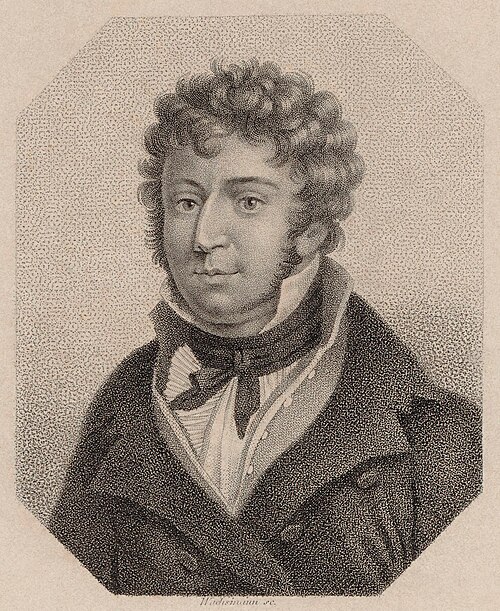
John Field was born in Dublin in 1782 and trained in London under Muzio Clementi, working partly as a showroom demonstrator for Clementi's piano-selling business - a job that gave him both deep knowledge of the instrument's capabilities and exposure to wealthy clientele across Europe. He eventually settled in St. Petersburg, where he spent most of his adult life teaching the Russian aristocracy and composing the pieces that would define his legacy. The nocturne form - a lyrical melody floating over a broken-chord accompaniment, shaped by long singing phrases and expressive ornamentation - was Field's invention, developed through the early decades of the 19th century before Frédéric Chopin encountered and transformed it.
Chopin heard Field perform in Paris and acknowledged his debt directly, describing Field's nocturnes as the model for his own. The relationship is audible: the textural formula of singing right-hand melody over flowing left-hand arpeggios is identical, and even the ornamentation style shares common ground. But where Chopin deepened the form harmonically and emotionally, Field's nocturnes retain a simpler, more purely song-like character - closer to the Romantic ideal of the voice singing without accompaniment than to the psychological complexity Chopin brought to the same template. The Fifth Nocturne in B-flat Major is one of the most accessible in Field's catalog, its melody open and unhurried.
Practice path
The original nocturne template, in its simplest form.
Field's Nocturne No. 5 is an ideal piece for learning the nocturne technique before tackling Chopin. Practice the left-hand arpeggios at 55% tempo until they feel completely effortless and quiet - they are the supporting texture, not the musical event. Then add the right-hand melody with full attention to its singing quality and phrase shape. The ornaments should be unhurried and natural; Field's notation is a guide, not a strict prescription.
Score basis: Generated MusicXML from Mutopia MIDI. Public domain composition; CC BY-SA 4.0; MusicXML generated for Pianodemy. Attribution: Mutopia Project (https://www.mutopiaproject.org/cgibin/piece-info.cgi?id=2137).
MIDI source: Mutopia Project (https://www.mutopiaproject.org/cgibin/piece-info.cgi?id=2137). CC BY-SA 4.0.
Questions
Before you practice.
Short answers for learners and for searchers deciding whether this is the right version to start with.
01Did John Field really invent the nocturne?
Field coined both the term and the form. He published nocturnes from 1814 onwards - predating Chopin's first published nocturne by several years. Chopin heard Field's playing (or his music) and took the intimate, song-like character for his own, amplifying it with a harmonic imagination Field could not match.
02How does Field's nocturne style differ from Chopin's?
Field's nocturnes are harmonically simpler and emotionally cooler than Chopin's - the accompaniment patterns are less varied and the dramatic contrasts are smaller. They feel like Classical-era miniatures with a Romantic sensibility, where Chopin's versions are fully Romantic in their chromatic richness and expressive extremes.
How to use this V1
The ancestor of Chopin, heard on its own terms.
Field's nocturnes are simpler harmonically than Chopin's, which means the expressive weight falls entirely on melodic shaping and tone. Use the loop feature on any phrase where the melody sounds mechanical - the piece has almost no technical complexity, so any unevenness is a phrasing issue rather than a finger issue. Full pedal on the left-hand arpeggios; change only when the harmony changes. Let the melody breathe through slight rubato at phrase endings.
Keep going