Interactive piano piece
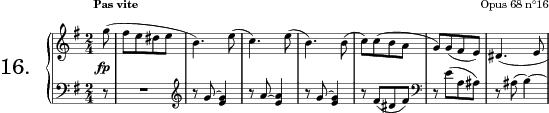
Learn First Sorrow, Op. 68 No. 16
A tender, melancholy piece in E minor that asks the late-beginner pianist to shape phrases with genuine feeling for the first time. Follow the score, slow down the playback, loop short sections, and try notes on the on-screen piano.
Browser MIDI check pending
Loading score...
Press Play for the full piece, or choose Opening and switch to Wait for note for guided right-hand practice.
About the piece
As students work through the Album for the Young, First Sorrow arrives as an emotional milestone - a minor-key piece that rewards expressive shading over mere accuracy, teaching that dynamics and phrase direction matter as much as the notes.
A tender, melancholy piece in E minor that asks the late-beginner pianist to shape phrases with genuine feeling for the first time.
Map the phrase arches before you play: find where each phrase rises and where it settles, then let your touch and volume follow that shape at a comfortable slow tempo.
Practice path
Start with short loops.
Use the section list as a practice map. Start at 50% tempo, loop one section, then return to the full piece once the hand shape feels stable.
Use Play along for the complete score. On selected pieces, Wait for note turns the opening phrase into a step-by-step keyboard exercise.
Score basis: Generated MusicXML from Mutopia MIDI. Public domain composition; CC BY-SA 2.5; MusicXML generated for Pianodemy. Attribution: Mutopia Project (https://www.mutopiaproject.org/cgibin/piece-info.cgi?id=676).
MIDI source: Mutopia Project (https://www.mutopiaproject.org/cgibin/piece-info.cgi?id=676). CC BY-SA 2.5.
Questions
Before you practice.
Short answers for learners and for searchers deciding whether this is the right version to start with.
01What level is Schumann's First Sorrow Op. 68 No. 16?
It sits at a late-beginner level - a step up from the earlier pieces in the Album for the Young. Students should be comfortable with basic two-hand coordination and simple hand position shifts before tackling it.
02What technique does First Sorrow develop?
The main skill is expressive phrasing in a minor key: shaping dynamic curves, connecting notes with a warm legato touch, and giving the melody a vocal, singing quality. It also introduces slightly longer phrases that need breath-like planning.
03How should I handle the minor key mood in this piece?
Play each phrase as if it were a sentence with its own emotional arc - a gentle rise and a quiet settling. Avoid uniform loudness throughout; the contrast between softer and slightly fuller moments is what gives the piece its character.
Keep going