Kleine Studie, Op. 68 No. 14 (Album for the Young)
The first real test hidden inside a children's album.
Kleine Studie ('Little Study') is one of the most demanding pieces in the first half of Album for the Young (Op. 68, 1848). Despite its modest title, it presents a continuous stream of arpeggiated figures that must flow evenly through both hands, making it a genuine coordination exercise disguised as charming salon music.
Schumann placed it at No. 14, just past the midpoint of the easier first half, as if to signal that childhood is giving way to something more serious. Teachers have used it for generations as a gateway étude: technically focused but never dry, and always singing.
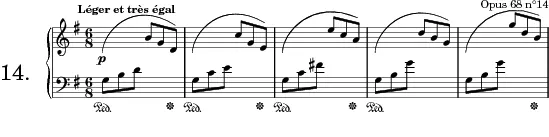
Even arpeggios before musical shape.
Practise the arpeggiated figures hands separately at 50% tempo, listening for a perfectly even touch on every note. Only when both hands are reliable individually should you combine them - then gradually raise the tempo while keeping the evenness.
MIDI based on the Mutopia Project edition , licensed Creative Commons Attribution-ShareAlike 2.5.
Before you practice.
01 What technical skill does Schumann's Kleine Studie develop?
The piece trains even, controlled finger motion in continuous 6/8 groups. Playing both hands together at a steady, light piano dynamic builds the independence and coordination needed for faster passage work in intermediate and advanced repertoire.
02 How long does it take to learn Schumann Kleine Studie Op. 68 No. 14?
Most intermediate students can read through the piece within a week and achieve a polished performance in three to six weeks. The challenge is not individual difficulty but sustaining an even touch across all 96 measures without rushing or accenting.
Evenness is the whole game.
Use slow-tempo mode to expose any bumps in the arpeggio stream. In wait-for-note mode, pause on each beat to check that your wrist is relaxed and not locked. Loop four-bar segments until the hand feels like water flowing downhill, then stitch them together.