The E Major Piano Scale: Four Sharps, No New Fingering
The E major piano scale has four sharps and looks intimidating on the page. The fingering is identical to C major. Here's why, and where the notes actually sit.
The key signature for E major, four sharps stacked on the staff, can make a student flinch before a single note is played. One sharp felt fine, two were mildly annoying, and four looks like a different category of problem entirely. The part that actually matters: the hand is going to do exactly what it already knows how to do.
That gap between how a key signature looks and how it plays is worth taking seriously, because it’s not really about E major. It’s about whether four sharps on the page can talk a student out of a scale their fingers would handle just fine.
What’s actually in it
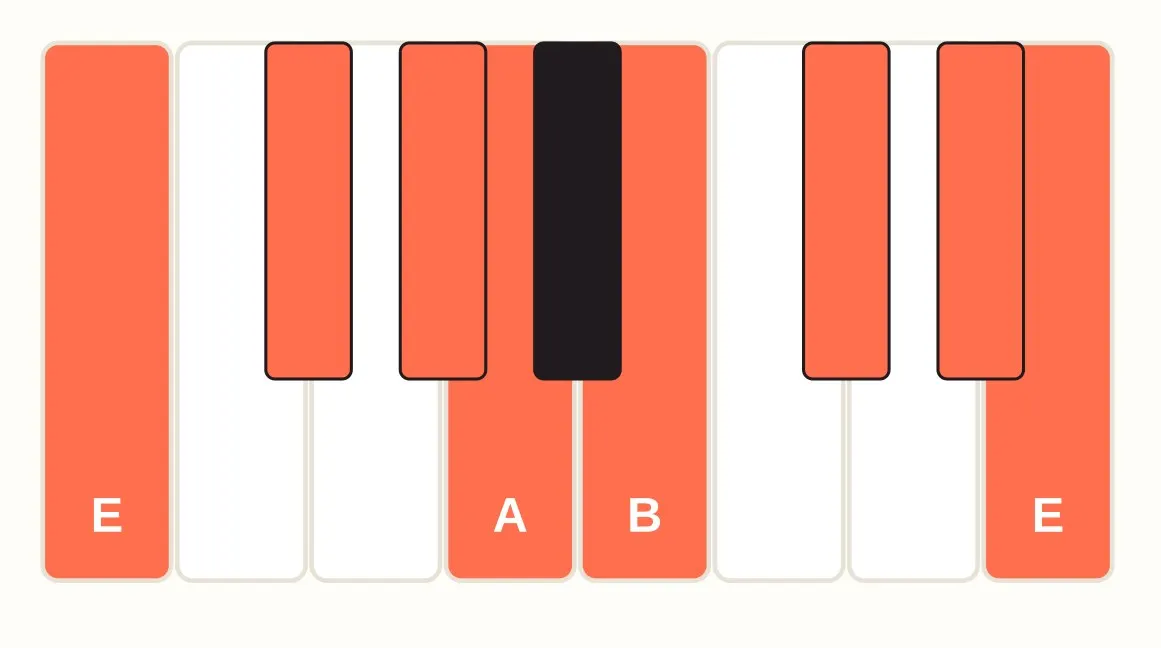
E major, ascending: E F# G# A B C# D# E. Four black keys, F sharp, C sharp, G sharp, and D sharp, three white keys, E, A, and B. Run the major scale pattern, whole, whole, half, whole, whole, whole, half, starting from E, and that’s exactly where it lands. Skip any one of those sharps and the scale stops resolving back to E; it starts leaning toward a key that isn’t the one you’re in.
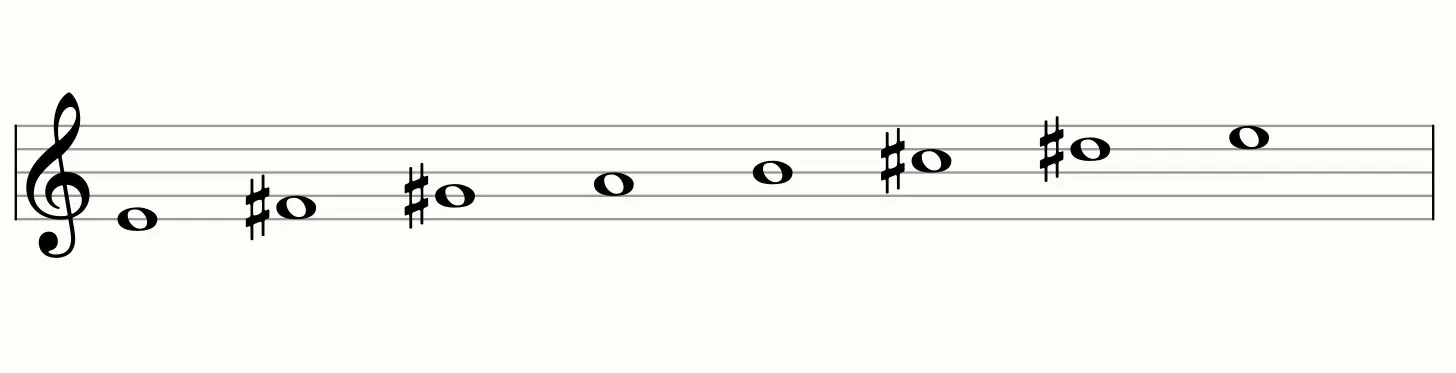
Here’s the part that surprises people: E major has more sharps than G or D major, but it isn’t a harder scale to hear or place under the hand. The black keys arrive in a cluster, F#-G# together, then C#-D# together, rather than scattered one at a time the way a single-sharp key does. Once a student’s ear catches that grouping, four sharps stops feeling like four separate problems and starts feeling like two.
The fingering you’ve already got
Right hand ascending, one octave: 1-2-3 on E, F#, G#, tuck the thumb under, then 1-2-3-4-5 on A, B, C#, D#, E. Left hand: 5-4-3-2-1 on E, F#, G#, A, B, then cross the third finger over for C#, D#, E. That’s the identical shape C major, D major, G major, and A major all use. Same tuck, same crossing point, same finger count.
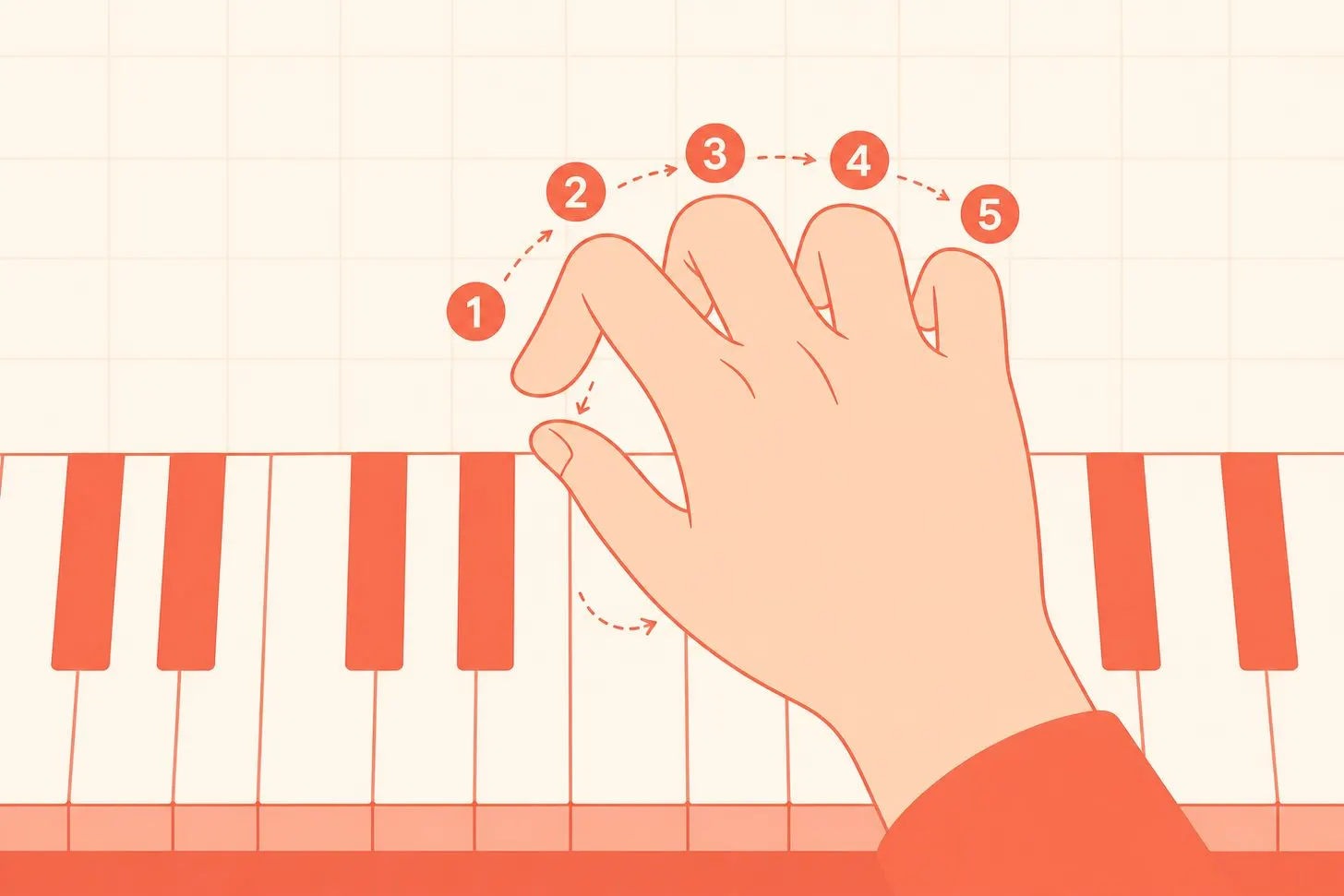
That’s not a coincidence, and it’s the actual reason E major is worth putting in front of intermediate students well before some of the easier-looking key signatures. F major breaks this pattern. So does B major. Both need a different fingering because their black keys don’t line up the same way relative to where the thumb wants to go. E major keeps the pattern intact even with four sharps in the key signature, which means a student who already has C major’s fingering in their hands can transfer it directly here without relearning the mechanics. The only new work is the notes themselves, not the motion.
The notes aren’t free, though. F sharp and C sharp show up often enough elsewhere that most students have them memorized before they ever reach this scale. G sharp and D sharp are a different story, particularly D sharp, which some students keep wanting to call E flat out of habit, even though on the page and under the fingers here it’s doing a completely different job.
Where it’s actually useful
E major’s relative minor is C sharp minor, same four sharps, different tonic. If you’ve already got a C sharp minor scale or chord under your fingers from somewhere else, you’re closer to E major than the key signature makes it look.
 Photo by
Beethoven wrote his Piano Sonata No. 30, Op. 109, in E major, one of his last three sonatas, and its opening arpeggios sit almost entirely inside this scale. You don’t need to be anywhere near ready for that piece to get something out of listening for it once the scale is comfortable. It’s a good check on whether the key actually sounds like something to you yet, or whether it’s still four abstract sharps on a page.
If the A major scale already sits comfortably under your hands, E major is the next stop in the same fingering family, one more sharp, same shape. Practice it the way you’d practice any new key: hands separately first, naming F#, G#, C#, D# out loud as your finger lands on each one, before you ever try it at tempo.
Want to catch the moment your hand reaches for E flat instead of D sharp? The E major scale page plays every exercise with you, one hand at a time, at the speed you set.
Play it here
Hear the scale, slow it down, practice one hand at a time, and play along on the clickable piano.
Frequently asked questions
What notes are in the E major piano scale?
E, F sharp, G sharp, A, B, C sharp, D sharp, and back to E. Four sharps: F#, C#, G#, and D#, out of seven notes.
Is the E major scale hard to play?
It looks harder than it is. Four sharps on the page makes it read as advanced, but the fingering is the same shape as C, D, G, and A major: right hand 1-2-3-1-2-3-4-5, left hand 5-4-3-2-1-3-2-1. The black keys just land where that fingering already expects them.
What's the relative minor of E major?
C sharp minor. Both keys share the same four sharps, F#, C#, G#, and D#. Play the E major scale's notes starting and ending on C sharp instead of E, and you have C sharp natural minor.
What's a well-known piece written in E major?
Beethoven's Piano Sonata No. 30 in E major, Op. 109, one of his late sonatas. It's an advanced piece, but its opening arpeggios sit almost entirely inside this scale, which makes it a useful thing to listen for once the scale is under your fingers.