Interactive piano piece
Learn Menuett in E-flat major, WoO 82
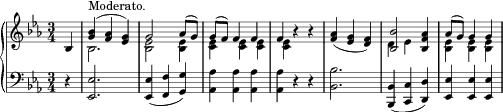
A graceful, early Beethoven minuet with a contrasting Trio section - clean Classical voice-leading throughout. The interactive practice desk loads the full score with playback, tempo control, and section loops - useful for isolating the trio section and the ornamental returns of the opening dance.
Browser MIDI check pending
Loading score...
Press Play for the full piece, or choose Opening and switch to Wait for note for guided right-hand practice.
About the piece
A minuet Beethoven wrote before the century turned.
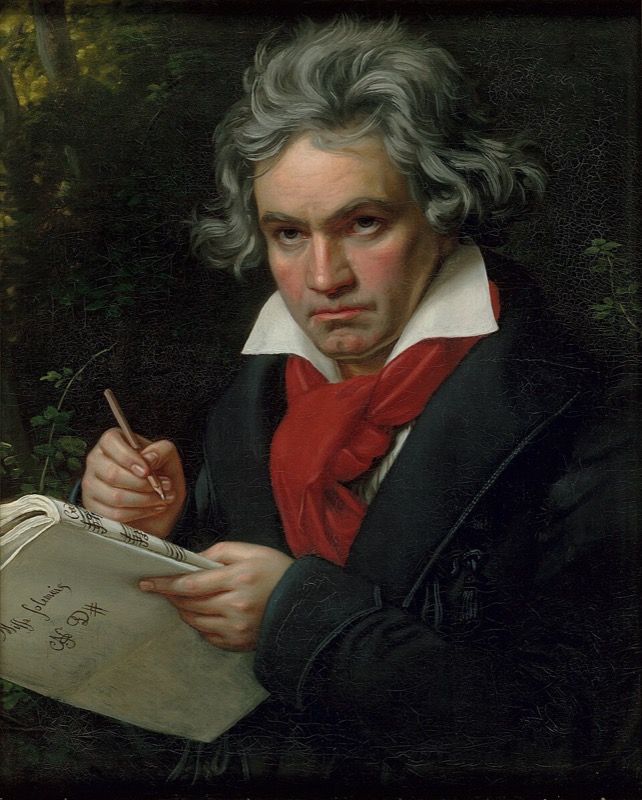
The Menuett in E-flat major, WoO 82, dates from around 1783, when Beethoven was twelve or thirteen years old and studying in Bonn under Christian Gottlob Neefe. It belongs to the category of Werke ohne Opuszahl - works without opus number - pieces Beethoven composed that were either unpublished in his lifetime or published without formal opus designation. The WoO catalogue, compiled by Georg Kinsky and Hans Halm in 1955, gathered these works into a coherent sequence.
The piece follows the standard Classical minuet-and-trio form: an opening dance in E-flat, a contrasting trio in the relative minor or a related key, and a return to the opening. As an early work it is undemanding harmonically, but it already shows the characteristic Beethoven directness - clear phrase shapes, a strong bass line, and an absence of decorative filling for its own sake. It is one of the earliest keyboard pieces attributed to Beethoven with reasonable certainty.
Practice path
Dance first, ornament second.
Begin with the opening minuet section at a true dance tempo - slightly slower than allegretto, with a clear three-beat lilt in each measure. Once the hands are coordinated, move to the trio and establish its contrasting character before drilling the return. The da capo repeat is not ornamental; it should feel like a genuine return to the dance.
Score basis: Generated MusicXML from Mutopia MIDI. Public domain composition; Public Domain (CC0) - Mutopia; MusicXML generated for Pianodemy. Attribution: Mutopia Project (https://www.mutopiaproject.org/cgibin/piece-info.cgi?id=904).
MIDI source: Mutopia Project (https://www.mutopiaproject.org/cgibin/piece-info.cgi?id=904). Public Domain (CC0) - Mutopia.
Questions
Before you practice.
Short answers for learners and for searchers deciding whether this is the right version to start with.
01Is Beethoven's Menuett WoO 82 suitable for beginners?
Yes, it is one of Beethoven's most accessible pieces. The note reading is straightforward and the texture is clear, though some of the voice-leading in the Trio rewards careful attention to balance.
02What does WoO mean in Beethoven's catalog?
WoO stands for 'Werke ohne Opuszahl,' meaning works without an opus number. Beethoven did not assign these pieces a formal opus, usually because they were early works or not intended for publication.
03What is minuet-and-trio form?
The Menuett plays first, then the Trio offers a contrasting section, and finally the Menuett returns (da capo). Learning to hear this ABA structure makes the piece feel coherent rather than a series of unrelated phrases.
How to use this V1
Keep the three-beat shape alive in both hands.
Practice each section hands-separately at 60% tempo, then combine at 75%. The minuet's charm lives in the phrasing: group every four bars as a single sentence with a slight lean on the first beat of each measure. Use the loop to fix any bar where the ornamental turns feel rushed. The trio's inner voices need balance - the melody should project clearly above the left-hand accompaniment throughout.
Keep going