Interactive piano piece
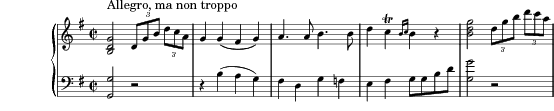
Learn Sonata Op. 49 No. 2, I. Allegro ma non troppo
A clean, friendly sonata first movement that introduces Classical phrase structure without the weight of the middle-period works. An interactive desk with full playback, tempo scaling, and section loops makes this movement practical to work through phrase by phrase - particularly useful for the development section where the hands frequently cross registers.
Browser MIDI check pending
Loading score...
Press Play for the full piece, or choose Opening and switch to Wait for note for guided right-hand practice.
About the piece
The sonata Beethoven held back for fifteen years.
Beethoven composed the two 'Easy' Sonatas of Op. 49 around 1795-96, likely as teaching pieces, but did not publish them. They remained in manuscript until 1805, when his brother Caspar Carl arranged publication - apparently without Beethoven's full consent. By then Op. 49 was long behind him compositionally; he was already working on the Appassionata. The G major sonata, No. 2, is the lighter of the pair, built from material that Beethoven also used in his Septet, Op. 20.
The first movement, Allegro ma non troppo, is a model of Classical clarity: a singing first theme in G major, a more energetic second theme, a brief development, and a textbook recapitulation. What makes it valuable as a teaching piece is not simplicity but proportion - every phrase is long enough to require real shaping, and the development asks the player to track a harmonic sequence through several keys without any supporting orchestral texture.
Practice path
Shape each theme before linking the sections.
Divide the movement into its three sections - exposition, development, recapitulation - and establish the character of each theme before working on transitions. The first theme needs a light, singing quality; the second theme is slightly more assertive. The development is the structural test: loop it at 70% to trace the harmonic sequence before restoring tempo. Once the recapitulation feels like a genuine homecoming rather than a repetition, the movement is ready.
Score basis: Generated MusicXML from Mutopia MIDI. Public domain composition; Public Domain; MusicXML generated for Pianodemy. Attribution: Mutopia Project (https://www.mutopiaproject.org/BeethovenLv/O49/LVB_Sonate_49no2_1/).
MIDI source: Mutopia Project (https://www.mutopiaproject.org/BeethovenLv/O49/LVB_Sonate_49no2_1/). Public Domain.
Questions
Before you practice.
Short answers for learners and for searchers deciding whether this is the right version to start with.
01Is Beethoven Op. 49 No. 2 a good first sonata?
Yes. It is one of the most approachable Beethoven sonatas - the phrases are clear, the textures are light, and the hand position stays manageable throughout the first movement.
02How long is the first movement of Op. 49 No. 2?
The Allegro ma non troppo runs 122 measures in cut time, typically around three to four minutes at a relaxed performance tempo.
03What is the main technical focus of this movement?
Clean articulation and even passagework. The exposed Classical texture means any unevenness in the running eighth notes is immediately audible, so slow looping of transition passages helps most.
How to use this V1
Let the development do its harmonic work.
At 50% tempo, right hand alone through the entire movement to establish the melodic shapes. At 65%, add the left hand and check that the Alberti bass in the opening theme stays light and even. The development contains the only real hand-coordination challenge; loop it separately at 60% until the voice leading is clear. Wait-for-note mode is helpful for the climactic bars of the development where both hands move in contrary motion.
Keep going