Mai, lieber Mai, Op. 68 No. 13 (Album for the Young)
A spring song tucked into a children's album.
Schumann composed Album for the Young (Op. 68) in the summer of 1848 as birthday music for his eldest daughter Marie. 'Mai, lieber Mai' - 'May, dear May' - is one of several pieces in the collection that borrow the mood, if not the notes, of German folk song. It sits at the midpoint of the album, bridging the simpler pieces for younger children and the more demanding works that follow.
The piece is cast in a gentle 3/4 that sways like a folksong chorus. Schumann wrote detailed performance instructions throughout the album, and this number rewards the player who matches its seasonal lightness: a singing right hand, a discreet left hand, and a sense that spring has just arrived.

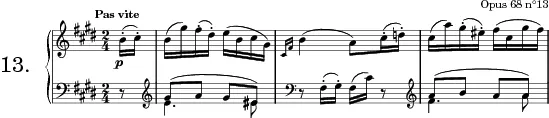
Find the folk-song lilt before the notes.
Count the 3/4 swing aloud - ONE two three, ONE two three - before playing a single key. Then practise the right-hand melody alone at 60% tempo until the line feels inevitable, and add the left hand only when the song is already in your ear.
MIDI based on the Mutopia Project edition , licensed Creative Commons Attribution-ShareAlike 2.5.
Before you practice.
01 What does 'Mai, lieber Mai' mean and what is the piece about?
The title translates roughly as 'May, dear May' - an affectionate address to the month of May as a symbol of spring. The piece captures the quiet longing for warmer days, which Schumann expressed through a gently flowing melody and gradually slowing tempo toward the end.
02 Is Schumann Op. 68 No. 13 suitable for beginners?
Yes, it is a beginner-level piece. The melody sits comfortably in the right hand, the left-hand accompaniment is straightforward, and the piece is short enough to learn in a week or two. The main challenge is following the expressive tempo changes Schumann writes into the score.
Balance and breath.
In slow-tempo mode, listen for the first beat to ring clearly above beats two and three. Use wait-for-note mode to reinforce phrasing: each melodic peak is a natural breath point. Loop the eight-bar refrain until it feels effortless before tackling the contrasting middle section.