Interactive piano piece
Learn Rundgesang, Op. 68 No. 26 (Album for the Young)
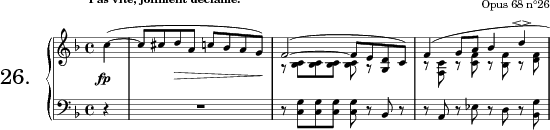
A warmly declaimed F major piece - the 'round song' of the Album for the Young - asking the pianist to project each phrase as clearly as a singer addressing a room. Loop the opening round to lock in the rhythmic feel, then carry that pulse through the entire piece.
Browser MIDI check pending
Loading score...
Press Play for the full piece, or choose Opening and switch to Wait for note for guided right-hand practice.
About the piece
A round sung at the piano.
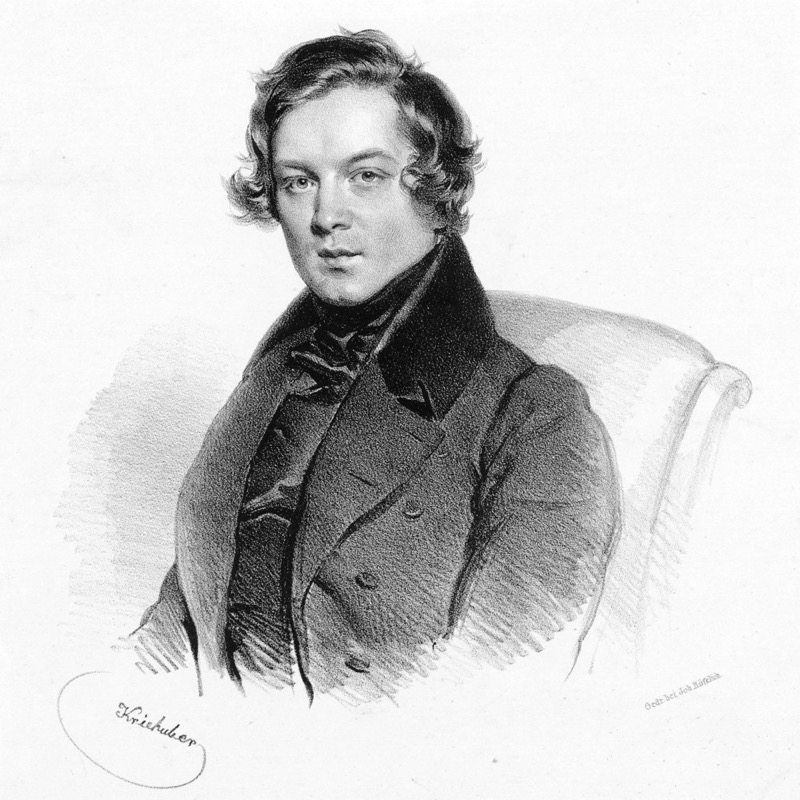
Rundgesang means 'round song' - the kind sung in a circle, where each voice enters in turn. Schumann captures this communal spirit at the piano in Op. 68 No. 26, a piece from the more advanced second half of Album for the Young (1848). The melody passes between registers in a way that suggests different voices joining the same refrain.
The piece reflects Schumann's deep interest in German folk culture and the social singing movement (Liedertafel) that was sweeping German cities in the 1840s. He imagined the Album not just as lesson music but as a way of bringing the whole family around the piano - and Rundgesang is the most literally communal piece in the collection.
Practice path
Hear the voices before you play.
Sing the opening melody, then sing it again an octave lower - now you have heard both 'voices.' At the piano, give each register its own tone colour, as if two singers are entering one after another. This imagination work, done slowly, is the whole practice.
Score basis: Generated MusicXML from Mutopia MIDI. Public domain composition; Creative Commons Attribution-ShareAlike 2.5; MusicXML generated for Pianodemy. Attribution: Mutopia Project (https://www.mutopiaproject.org/ftp/SchumannR/O68/schumann-op68-26-sans-titre/).
MIDI source: Mutopia Project (https://www.mutopiaproject.org/ftp/SchumannR/O68/schumann-op68-26-sans-titre/). Creative Commons Attribution-ShareAlike 2.5.
Questions
Before you practice.
Short answers for learners and for searchers deciding whether this is the right version to start with.
01Why is Schumann Op. 68 No. 26 sometimes called 'Rundgesang' and sometimes left untitled?
Schumann originally published this piece without a title, marking it with asterisks. Later editors assigned the name 'Rundgesang' (round song) based on its broad, community-song character. The title is editorial rather than Schumann's own, which is why different editions may label it differently.
02What does 'joliment déclamé' mean and how should it affect my playing?
The French marking means 'prettily declaimed' - play each phrase as if you were reciting poetry aloud, with natural emphasis and a slight breath between phrases. Avoid mechanical evenness: let the melodic line lead and shape the dynamics around it.
How to use this V1
Tone colour across registers.
Use slow-tempo mode to focus on the balance between registers: neither voice should dominate when both are present. In wait-for-note mode, pause at each register shift to reset your touch deliberately. Loop the passages where the 'voices' overlap - those bars are the heart of the piece.
Keep going