Interactive piano piece
Learn Sheherazade, Op. 68 No. 32 (Album for the Young)
A veiled, storytelling miniature in A minor - Schumann's tribute to the legendary narrator of One Thousand and One Nights, written for pianists ready to paint in sound rather than just play notes. Slow the tempo and let the exotic colour of the harmony land - this piece works best when each chord is savoured.
Browser MIDI check pending
Loading score...
Press Play for the full piece, or choose Opening and switch to Wait for note for guided right-hand practice.
About the piece
One Thousand and One Nights at the piano.
By Op. 68 No. 32, Album for the Young has left the village green far behind. Sheherazade - named for the Persian queen who saved her life by telling tales - is one of the most harmonically adventurous pieces in the collection. Schumann uses chromatic colouring and an unusual modal flavour to evoke something distant and mysterious, in the spirit of the Romantic fascination with the orient.
The 1848 album was written quickly, but Schumann had been absorbed by the Thousand and One Nights for years. This miniature distils that fascination into two pages: a storyteller's voice that rises and falls, pauses for effect, and always finds its way back to the thread of the tale.
Practice path
Colour before speed.
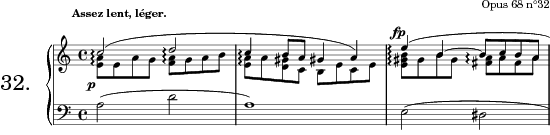
Play through the piece at half tempo and mark every chromatic note with a pencil. Then play again, deliberately leaning into those altered pitches - they are not mistakes, they are the story. Speed comes last; the exotic character must be established first.
Score basis: Generated MusicXML from Mutopia MIDI. Public domain composition; Creative Commons Attribution-ShareAlike 2.5; MusicXML generated for Pianodemy. Attribution: Mutopia Project (https://www.mutopiaproject.org/ftp/SchumannR/O68/schumann-op68-32-sheherazade/).
MIDI source: Mutopia Project (https://www.mutopiaproject.org/ftp/SchumannR/O68/schumann-op68-32-sheherazade/). Creative Commons Attribution-ShareAlike 2.5.
Questions
Before you practice.
Short answers for learners and for searchers deciding whether this is the right version to start with.
01Who is Sheherazade and why did Schumann write a piano piece about her?
Sheherazade is the legendary narrator of One Thousand and One Nights, a collection of Middle Eastern folk tales. She saved her own life by telling the king a new story each night, always ending on a cliffhanger. Schumann was drawn to the idea of music as storytelling without words, and named this piece to evoke the same atmosphere of suspense and wonder.
02What level is Schumann's Sheherazade Op. 68 No. 32?
It is an intermediate piece, suited to students who are comfortable with both hands in a slow, sustained 4/4 texture. The main challenge is maintaining a truly quiet, atmospheric tone throughout without the melody becoming mechanical - a musical maturity rather than a purely technical hurdle.
How to use this V1
Let the harmony breathe.
Use slow-tempo mode to hear each chromatic shift clearly. In wait-for-note mode, pause on any note that surprises you and listen to where it wants to resolve. Loop the most harmonically dense passages - often just two bars - until their logic feels as natural as a major scale.
Keep going