Interactive piano piece
Learn Étude in C-sharp minor, Op. 2 No. 1
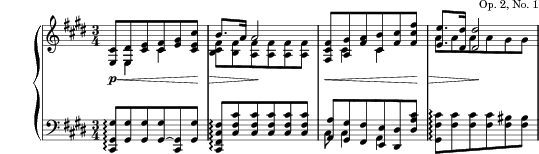
Scriabin's most beloved early étude - 45 measures of sighing, Chopin-inflected melody over a rocking arpeggiated bass that sounds like a nocturne but demands the precision of an étude. The Op. 2 No. 1 Etude is Scriabin's most accessible entry point - use the Pianodemy desk to loop the opening eight bars and feel how the left-hand accompaniment needs to breathe beneath the singing right-hand melody.
Browser MIDI check pending
Loading score...
Press Play for the full piece, or choose Opening and switch to Wait for note for guided right-hand practice.
About the piece
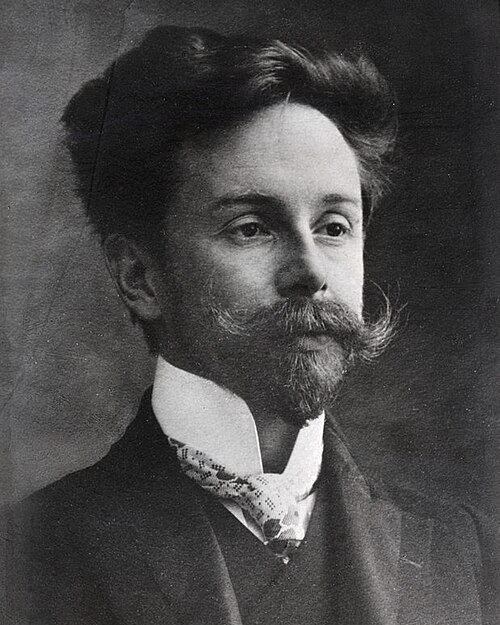
The teenage Scriabin, already unmistakably himself.
Alexander Scriabin composed his Etude in C-sharp minor, Op. 2 No. 1 in 1887, when he was fifteen years old and a student at the Moscow Conservatory. The piece already carries the hallmarks that would define his early mature style: a richly chromatic harmony that owes much to Chopin, a long-breathed melodic line that sits in the right hand and asks for a singing tone, and an accompaniment pattern in the left hand that must pulse without intruding. Scriabin had damaged his right hand through over-practicing in his early conservatory years, and some of his early pieces - including this etude - reflect an attempt to strengthen the hand while exploring expressive possibilities within physical limitation.
The Op. 2 No. 1 Etude has remained one of the most beloved pieces in Scriabin's catalog precisely because it distills his essential voice into a compact, technically approachable form. The harmonic language sits squarely in the late-Romantic tradition - Chopin and early Liszt are audible influences - while the emotional temperature is distinctively Scriabin's: intense but inward, passionate without being demonstrative. It is a portrait of a composer whose late work would push tonality to its breaking point, here still inside the inherited language but already bending it toward something new.
Practice path
Singing right hand, breathing left hand.
The right-hand melody must sound completely legato, as if sung rather than played. Practice it alone at 60% tempo with full pedal, shaping each long phrase with a slight swell and decay. The left hand's accompanying pattern should feel like a heartbeat - present and regular but never intrusive. At 70% tempo hands together, check that the melody is clearly louder than the accompaniment at all times.
Score basis: Generated MusicXML from Mutopia MIDI. Public domain composition; Public Domain (CC0) - Mutopia; MusicXML generated for Pianodemy. Attribution: Mutopia Project (https://www.mutopiaproject.org/cgibin/piece-info.cgi?id=1029).
MIDI source: Mutopia Project (https://www.mutopiaproject.org/cgibin/piece-info.cgi?id=1029). Public Domain (CC0) - Mutopia.
Questions
Before you practice.
Short answers for learners and for searchers deciding whether this is the right version to start with.
01Is Scriabin Op. 2 No. 1 considered a nocturne or an étude?
It is formally an étude - the Op. 2 set was designated as études and the piece trains a specific skill (sustained melody over flowing arpeggios). But its slow tempo, singing character, and emotional depth give it the feel of a nocturne, and it is often programmed alongside nocturne-style pieces.
02What grade level is Scriabin Étude Op. 2 No. 1?
It sits at around RCM Grade 8-9 or ABRSM Grade 7-8 (advanced). The technical demands are manageable - there are no virtuosic hand-crossings or extreme stretches - but the musical requirements (tone balance, pedalling, phrasing) demand real artistry.
How to use this V1
Chopin's student, not Chopin's copy.
Scriabin's harmonic language here is close to Chopin's nocturnes but the emotional quality is different - more feverish, more urgent. Let the chromatic inner-voice movements in the left hand be audible without becoming dominant. Use the loop feature on any phrase where the legato line breaks; this is the primary technical challenge and also the key to the piece's expressive character.
Keep going