Interactive piano piece
Learn Prelude in F minor WoO 55
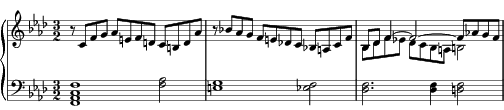
A searching, improvisatory Prelude in F minor written by a 17-year-old Beethoven - 48 bars of chromatic wandering that hint at the stormy keyboard voice he would develop in the Pathétique and beyond. The interactive score's tempo control is particularly useful here - the prelude's continuous motion demands absolute evenness, and building that at 60% before stepping up is the most reliable path.
Browser MIDI check pending
Loading score...
Press Play for the full piece, or choose Opening and switch to Wait for note for guided right-hand practice.
About the piece
A through-all-keys exercise Beethoven turned into a character piece.
The Prelude in F minor, WoO 55, is one of Beethoven's most unusual small pieces. Composed around 1787 - when Beethoven was just seventeen and had recently arrived in Vienna for a brief, unsuccessful attempt to study with Mozart - it belongs to a tradition of keyboard preludes designed to pass through all twenty-four major and minor keys. Beethoven wrote a companion prelude for the same purpose, but this F-minor example has a seriousness that goes well beyond pedagogical demonstration.
The piece moves through a cycle of keys using a continuous semiquaver texture in the right hand against a steady left-hand bass. What is striking is how the harmonic motion generates genuine tension and release - Beethoven was not simply completing an exercise but finding drama within the constraint. The final bars return to F minor with an authority that suggests the young composer already understood how to close an argument.
Practice path
Build absolute evenness in the semiquaver right-hand line.
The right hand's continuous semiquaver motion is the technical and musical foundation of this prelude. Practice it alone at 55% tempo with a light touch until every note is exactly the same length and dynamic - any unevenness becomes audible at full tempo. Add the left hand and check that the bass notes anchor each harmonic shift without becoming heavy. Loop the transition passages between key areas at 65% to keep the harmonic logic clear.
Score basis: Generated MusicXML from Mutopia MIDI. Public domain composition; Public Domain; MusicXML generated for Pianodemy. Attribution: Mutopia Project (https://www.mutopiaproject.org/ftp/BeethovenLv/WoO55/prelude_WoO55/).
MIDI source: Mutopia Project (https://www.mutopiaproject.org/ftp/BeethovenLv/WoO55/prelude_WoO55/). Public Domain.
Questions
Before you practice.
Short answers for learners and for searchers deciding whether this is the right version to start with.
01What does WoO mean in Beethoven's catalogue?
'WoO' stands for 'Werk ohne Opuszahl' - German for 'work without opus number.' These are pieces Beethoven did not assign an opus number to, often early works or occasional pieces published posthumously.
02How does Beethoven's WoO 55 Prelude compare to Für Elise?
Both are early Beethoven keyboard works, but they differ in character. Für Elise (WoO 59) is gentle and song-like; WoO 55 is darker and more harmonically adventurous, making it a rewarding choice for students who want to explore Beethoven's more brooding side.
How to use this V1
Evenness and harmonic awareness in equal measure.
At 55% tempo, play the right hand alone and listen for any finger that is louder or shorter than its neighbours - the cycle-of-keys structure requires absolute consistency to feel inevitable rather than arbitrary. When both hands play, the left hand should be clearly softer than the right. At 80%, listen specifically at each key change to ensure the new tonal area registers emotionally before the motion continues. The final cadence in F minor should feel like an arrival, not a stopping point.
Keep going