Interactive piano piece
Learn Sonata Op. 49 No. 2 - Allegro ma non troppo
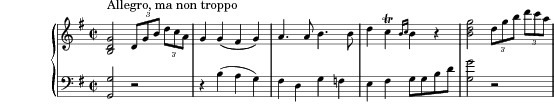
The bright, singing Allegro ma non troppo that opens Beethoven's 'Easy Sonata' Op. 49 No. 2 in G major - the most commonly assigned Beethoven sonata movement for advancing students. The interactive score is ideal for working the Alberti bass in isolation before pairing it with the melody - a combination that needs to feel effortless at performance tempo.
Browser MIDI check pending
Loading score...
Press Play for the full piece, or choose Opening and switch to Wait for note for guided right-hand practice.
About the piece
The most taught Beethoven sonata movement in the world.
The Allegro ma non troppo that opens Sonata Op. 49 No. 2 is probably the most widely studied Beethoven sonata movement among early intermediate pianists. Composed around 1796-97 and, like its companion, published only in 1805 by Beethoven's brother without the composer's consent, it became a pedagogical staple precisely because Beethoven kept his demands moderate without sacrificing musical interest. The opening theme in G major is a model of Classical proportion - eight bars, two phrases, balanced and clear.
The movement unfolds in clean sonata form: a sunny opening theme, a more flowing second theme in D major, a compact development that touches on minor keys without real drama, and a recapitulation that returns everything to G major. The left hand's Alberti bass is constant but never heavy. Beethoven seems to have written the piece partly as a teaching exercise - its challenges are real but appropriately scaled, which is exactly why it has endured.
Practice path
Tame the Alberti bass before combining hands.
The left hand's Alberti bass is the technical core of this movement. Practice it alone at 60% tempo until it feels automatic - the wrist should stay relaxed and the dynamic level low. Once the left hand is secure, add the right hand and check that the melody projects clearly above the accompaniment at all times. The second theme in D major is slightly more lyrical; loop it separately to find the right balance between the two hands before connecting it to the exposition.
Score basis: Generated MusicXML from Mutopia MIDI. Public domain composition; Public Domain; MusicXML generated for Pianodemy. Attribution: Mutopia Project (https://www.mutopiaproject.org/ftp/BeethovenLv/O49/LVB_Sonate_49no2_1/).
MIDI source: Mutopia Project (https://www.mutopiaproject.org/ftp/BeethovenLv/O49/LVB_Sonate_49no2_1/). Public Domain.
Questions
Before you practice.
Short answers for learners and for searchers deciding whether this is the right version to start with.
01Is Beethoven Op. 49 No. 2 good for Grade 5-6 students?
Yes - it is widely used at the ABRSM/RCM Grades 5-6 range. The notes are accessible but the musicianship demands (balance, voicing, phrasing) reward students who have developed listening skills.
02How does Op. 49 No. 2 compare to the famous Für Elise?
Für Elise (WoO 59) is a single-movement bagatelle at a similar difficulty level. The Op. 49 No. 2 Allegro is longer and develops standard sonata-form thinking, making it a more complete piece for students building their repertoire.
How to use this V1
Keep the Alberti bass quiet and the melody singing.
At 65% tempo, play the left hand alone and listen for any tension in the forearm - the Alberti pattern should flow without effort. When both hands play, the melody should be clearly audible at the other side of a room. The development is brief but introduces some minor-key material; loop it at 70% to keep the voice leading clear. At full tempo, the movement should feel light and conversational, not driven.
Keep going