Interactive piano piece
Learn Piano Sonata No. 25 in G major, Op. 79: II. Andante
A brief, introspective slow movement in G minor - compact enough to learn in a single session. The practice desk lets you loop any phrase of the singing Andante at tempo, hear the two-voice texture separately, and use wait-for-note mode to nail the melodic line before adding the bass.
Browser MIDI check pending
Loading score...
Press Play for the full piece, or choose Opening and switch to Wait for note for guided right-hand practice.
About the piece
The quiet heart of a deliberately light sonata.
Beethoven composed the Piano Sonata in G major, Op. 79, in 1809 - the same year as the Emperor Concerto and the Harp Quartet, though the sonata belongs to an entirely different emotional register. He described it himself as a 'Sonatine,' signalling that it was intended to be approachable and unpretentious. The work was published in Vienna in 1810 by Breitkopf und Härtel.
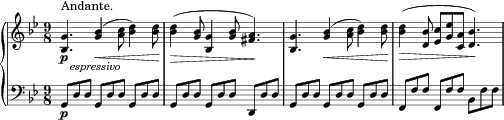
The second movement, marked Andante in G minor, is a barcarolle - a rocking, boat-song form in 9/8 time. The left hand traces a gentle swaying figure that never stops, while the right hand sings a long-breathed melody above it. The combination creates a quality of sustained, unhurried lyricism that sits apart from the playful outer movements. It is one of Beethoven's most transparent textures: two voices, clear as glass, moving together through the minor key without drama.
Practice path
Sustain the singing line over the rocking bass.
The central challenge is balance: the left-hand barcarolle figure must be completely even and quiet so the right-hand melody can float above it without effort. Begin with the left hand alone until the rocking 9/8 pattern is automatic, then add the melody and immediately check that it projects. The middle section modulates to the relative major - loop that transition separately to secure the harmonic shift.
Score basis: Generated MusicXML from Mutopia MIDI. Public domain composition; Public Domain (CC0) - Mutopia; MusicXML generated for Pianodemy. Attribution: Mutopia Project (https://www.mutopiaproject.org/cgibin/piece-info.cgi?id=956).
MIDI source: Mutopia Project (https://www.mutopiaproject.org/cgibin/piece-info.cgi?id=956). Public Domain (CC0) - Mutopia.
Questions
Before you practice.
Short answers for learners and for searchers deciding whether this is the right version to start with.
01Is the Op. 79 Andante good for intermediate players?
Yes. It is technically approachable but musically rich. The short length means you can learn the whole movement quickly, then spend time on tone, phrasing, and balance.
02Why is this movement in G minor when the sonata is in G major?
Beethoven shifts to the parallel minor for the slow movement, which was a common Classical-era technique to add emotional contrast between the outer movements.
03Can I learn this movement without playing the first movement first?
Yes. Each movement of this sonata is approachable independently. The Andante stands well on its own as a short lyrical study.
How to use this V1
Let the 9/8 rock without interference.
Set the tempo to 60% and practice the left hand alone for several passes - it must be soft and absolutely regular before the melody enters. At 75%, add the right hand and listen from the bass upward: the melody sits on top but the barcarolle carries the motion. Use the section loop on the middle modulation; the chromatic inner voices need care. The movement is short; one careful run-through at 85% should reveal any remaining unevenness.
Keep going