Interactive piano piece
Learn Inquiétude, Op. 100 No. 18
A restless Allegro agitato in E minor that drives triplet figures between the hands to capture a feeling of anxious unease. The interactive desk loads the restless triplet score and lets you isolate and loop the critical hand-crossing gesture at any tempo - the ideal way to make the cross feel automatic before threading it into the full piece.
Browser MIDI check pending
Loading score...
Press Play for the full piece, or choose Opening and switch to Wait for note for guided right-hand practice.
About the piece
The étude that bridges beginner and intermediate - triplets, hand-crossing, and nervous energy in E minor.
Burgmüller's 25 Études faciles Op. 100, published in Paris around 1838, is the world's most-taught beginner piano collection. Most of its études sit comfortably at the beginner level; Inquiétude - No. 18 - reaches further. Placed late in the set deliberately, it is the étude that shows a student they have left the beginner stage behind.
Inquiétude means 'Restlessness' or 'Anxiety' in French - and the piece sounds exactly that way. In E minor and 2/4 time, Allegro agitato, it drives triplet figures between the hands in a hand-crossing pattern that demands both physical coordination and confident rhythm. The fortissimo-piano contrasts are sudden and unforgiving: one moment turbulent, the next hushed. These alternating dynamic extremes, combined with the hand-crossing triplets, introduce the student to the expressive range and technical precision that define early-intermediate piano playing.
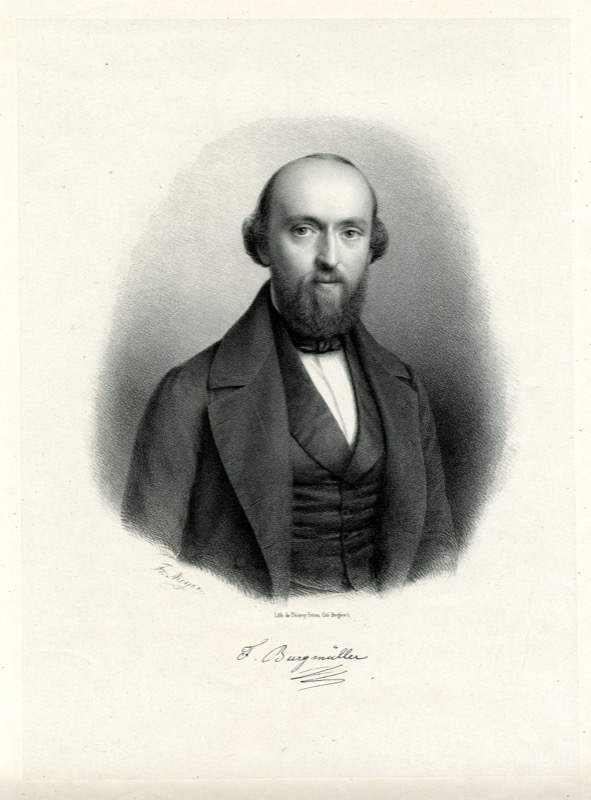

Practice path
Isolate the cross before you run the piece.
The hand-crossing triplet gesture is the technical core: one hand plays its triplet, then reaches over or under to a new register for the next one. Practice just this gesture in isolation - without any other notes - at a very slow tempo until the arm crosses without hesitation or tension. The arm should float across freely; any gripping in the shoulder or wrist will cause missed notes at speed. Once the cross is automatic in both directions, thread it back into the first four measures, then expand outward.
Score basis: Generated MusicXML from Mutopia MIDI. Public domain composition; Public Domain (CC0) - Mutopia; MusicXML generated for Pianodemy. Attribution: Mutopia Project (https://www.mutopiaproject.org/cgibin/piece-info.cgi?id=230).
MIDI source: Mutopia Project (https://www.mutopiaproject.org/cgibin/piece-info.cgi?id=230). Public Domain (CC0) - Mutopia.
Questions
Before you practice.
Short answers for learners and for searchers deciding whether this is the right version to start with.
01What level is Burgmüller Inquiétude Op. 100 No. 18?
It is rated late-beginner to early-intermediate. The triplet figures and hand-crossing pattern are more technically advanced than earlier études in the set - a natural step up after mastering the simpler Op. 100 pieces.
02What does Inquiétude teach technically?
It develops triplet cross-hand technique, crisp rhythmic articulation in 2/4 time, and the ability to execute sharp dynamic contrasts - skills that bridge the gap between beginner and intermediate repertoire.
How to use this V1
The contrast is as important as the notes.
Set the tempo slider to 50% and work the forte and piano passages with exaggerated contrast - louder than you think for forte, softer than you think for piano - because dynamic range compresses at slow tempo. At performance speed the exaggerated contrast will arrive as exactly the right level. Loop the transitions between the dynamic extremes specifically, since hesitating before a sudden piano or forte blurs the nervous energy that defines Inquiétude. This is the hardest étude in the selection - budget two to three weeks of patient slow practice before attempting full tempo.
Keep going