Interactive piano piece
Learn Valse Op. 64 No. 1 (Minute Waltz)
A sparkling D-flat major waltz nicknamed 'Minute' for its minute quality rather than its target tempo - speed comes only after the finger-work is clean. Interactive score, tempo slider from 40% to full speed, section loops, and wait-for-note mode let you build the right-hand run clean note by note before chasing the famous tempo.
Browser MIDI check pending
Loading score...
Press Play for the full piece, or choose Opening and switch to Wait for note for guided right-hand practice.
About the piece
The waltz nicknamed for its character, not its clock.
The Waltz in D-flat major, Op. 64 No. 1, was published in 1847 - just two years before Chopin's death - as the first of a set of three waltzes dedicated to different friends. It is the last set of waltzes he prepared for publication himself, and the D-flat waltz that opens it became his most performed and most misunderstood composition. The nickname 'Minute Waltz' has nothing to do with a time target: 'minute' here means tiny or delicate, derived from the French 'menuet,' and refers to the filigree quality of the right-hand perpetual-motion figure rather than any instruction to play it in 60 seconds.
George Sand's dog is traditionally said to have inspired the opening spinning figure - the dog chased its own tail while Chopin improvised, and the resulting motif became the waltz's signature. Sand herself neither confirmed nor denied the story. What is certain is that Chopin composed the piece during the later years of his illness, when his technical demands on pianists remained undiminished despite his own hands weakening. The waltz contains a quieter middle section - the trio in D-flat minor - that many pianists underplay, rushing past it to return to the fireworks. That trio is where the piece's real depth lives.
Practice path
Evenness in the run, depth in the trio.
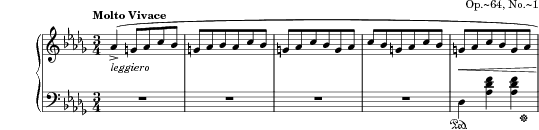
The opening right-hand spinning figure - a continuous stream of eighth notes in D-flat major - must be even: no finger pokes out, no note disappears. Practice it in four-bar groups at 50% tempo, isolating the hand position shifts that happen across the figure. The left-hand waltz bass (one note plus two chords per bar) must stay soft enough that the right hand dominates throughout the opening section.
The trio in D-flat minor deserves real musical attention. Slow it down separately, shape the two-bar phrases as a conversation between a question and a half-answer, and allow a small ritardando at the ends of phrases. Many pianists play the trio mechanically because they are thinking ahead to the return - resist that impulse. The trio's quieter introspection is what gives the reprise its impact.
Score basis: Generated MusicXML from Mutopia MIDI. Public domain composition; UNKNOWN - confirm from .ly header; MusicXML generated for Pianodemy. Attribution: Mutopia Project (https://www.mutopiaproject.org/ftp/ChopinFF/O64/chopin_valse_op64_no1/).
MIDI source: Mutopia Project (https://www.mutopiaproject.org/ftp/ChopinFF/O64/chopin_valse_op64_no1/). UNKNOWN - confirm from .ly header.
Questions
Before you practice.
Short answers for learners and for searchers deciding whether this is the right version to start with.
01Does 'Minute Waltz' mean it should be played in one minute?
No - 'minute' here means tiny or delicate, not a time target. Playing it in exactly one minute at the cost of evenness misses the point. Let the finger-work be clean first.
02What level is the Minute Waltz?
The piece is intermediate. The notes fall naturally under the hand in D-flat major, but the right-hand runs require light, even fingers and relaxed wrist rotation at tempo.
How to use this V1
Build the run from the slowest speed you can manage evenly.
Find the slowest tempo at which every note of the right-hand run is exactly equal - that is your starting point. Increase by 5% increments only when each step is even. The thumb positions (where D-flat major crosses under or over) are where unevenness hides; section-loop those two bars until they flow. For the trio, use wait-for-note mode to feel where the melodic phrases want to linger naturally - those are the rubato points. Full-speed performance without evenness at 50% first is the common mistake this piece punishes.
Keep going