Interactive piano piece
Learn Piano Sonata No. 16 in C major, K. 545: III. Rondo
The lively finale of Mozart's Sonata facile - a rondo refrain that returns with a smile after each contrasting episode. Section loops and tempo scaling on the practice desk let you drill the fast passage-work in the development and the hand-crossing figures in the recapitulation until they feel automatic.
Browser MIDI check pending
Loading score...
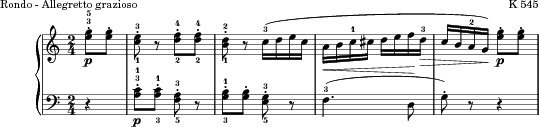
Press Play for the full piece, or choose Opening and switch to Wait for note for guided right-hand practice.
About the piece
The finale that closes Mozart's teaching sonata at a sprint.
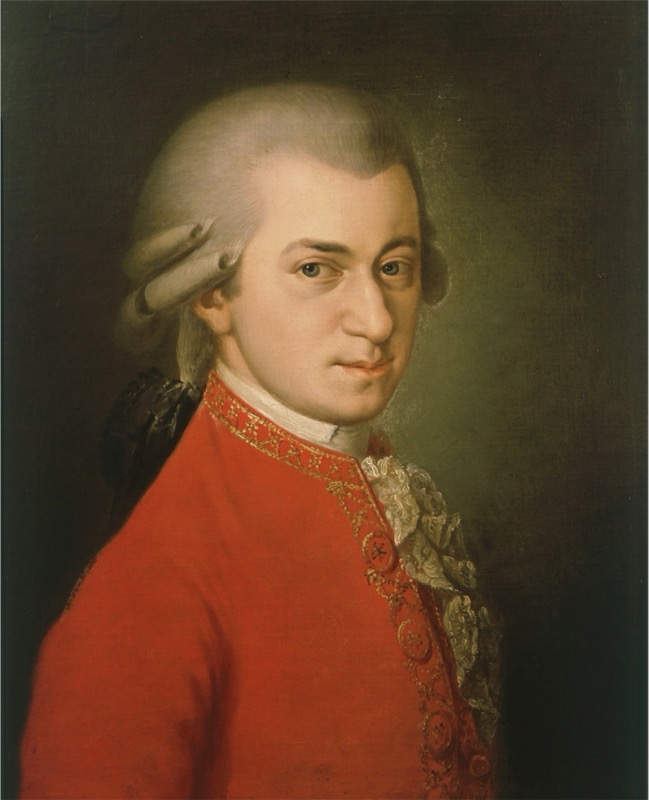
The third movement of K. 545, marked Rondo - Allegretto, rounds out the sonata Mozart described as 'for beginners' in June 1788. Where the first movement laid out classical sonata form with textbook clarity and the second offered a reflective Andante in G, the finale restores C major and a brisk, forward-moving energy. The rondo structure - ABACABA - gives the movement its shape, with the lighthearted main theme returning like a refrain between contrasting episodes.
Despite the 'beginners' label, the finale places real demands on coordination. The right hand carries fast scalar passages and ornamental turns while the left hand tracks a continuous bass pattern that shifts character between episodes. The most challenging passage is the development-like central section, where the texture briefly thickens and the harmonic rhythm accelerates. Mozart's instruction was 'for beginners' in the sense of being pedagogically structured - not in the sense of being technically easy.
Practice path
Lock the rondo theme first, then clear the episodes.
The rondo theme in C major is the anchor for the whole movement: once it feels fluent and light, the episodes become manageable in context. Work the A theme at 60% with both hands until the ornamental turns are clean, then loop each episode separately at 65%. The central C section is the structural crux; isolate it and work through the harmonic sequence before rejoining it to the surrounding A sections.
Score basis: Generated MusicXML from Mutopia MIDI. Public domain composition; CC BY-SA 3.0; MusicXML generated for Pianodemy. Attribution: Mutopia Project (https://www.mutopiaproject.org/cgibin/piece-info.cgi?id=1027).
MIDI source: Mutopia Project (https://www.mutopiaproject.org/cgibin/piece-info.cgi?id=1027). CC BY-SA 3.0.
Questions
Before you practice.
Short answers for learners and for searchers deciding whether this is the right version to start with.
01How does the Rondo finale compare to the first movement?
The Rondo is lighter and shorter. Where the first movement has longer scale passages and full Alberti bass throughout, the Rondo trades in smaller motifs and cleaner textures.
02What is rondo form?
Rondo form features a main refrain (A) that returns between contrasting episodes (B, C). Recognizing when the main theme returns is part of what makes listening to and playing a rondo satisfying.
03Is this a good piece for learning classical articulation?
Yes. The short motivic phrases and light texture make it an ideal piece for practicing detached (non-legato) touch and clean, stylistically appropriate Classical articulation.
How to use this V1
Keep the Allegretto moving - it cannot drag.
This movement loses its character if practiced too slowly for too long. Spend time at 55% for note-learning, but move to 80% as soon as the notes are secure to feel the proper forward motion. The left-hand bass pattern changes character in each episode - check for evenness in each new context separately. Wait-for-note mode is most useful in the ornamental bars of the rondo theme; use the loop to run those bars at full tempo once they are secure.
Keep going