Interactive piano piece
Learn Le Courant limpide, Op. 100 No. 7
A lively Allegro in G major that portrays a clear, rippling stream through continuous right-hand eighth-note runs. The interactive desk streams the score with real-time highlighting and lets you slow the Allegro passages to half speed - exactly what continuous right-hand scale figures demand when you first learn them.
Browser MIDI check pending
Loading score...
Press Play for the full piece, or choose Opening and switch to Wait for note for guided right-hand practice.
About the piece
A rippling stream in G major - 16 measures of pure passage work.
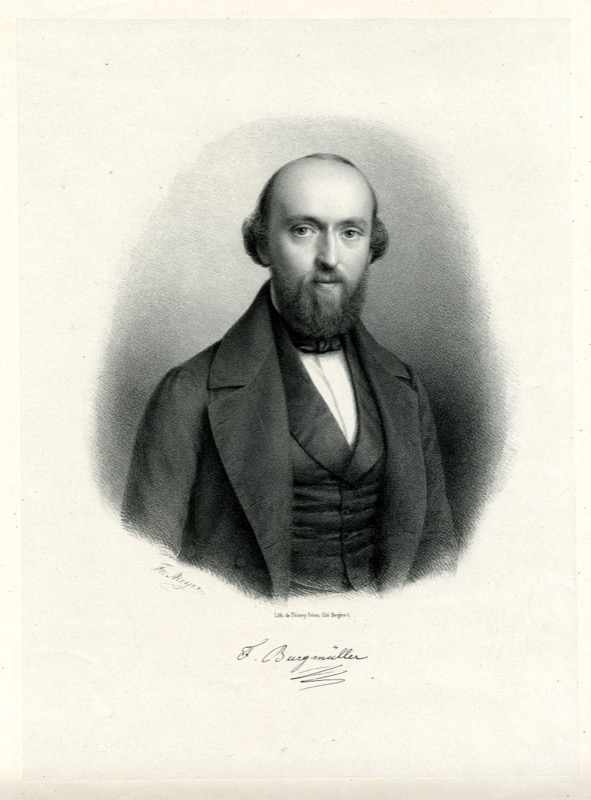
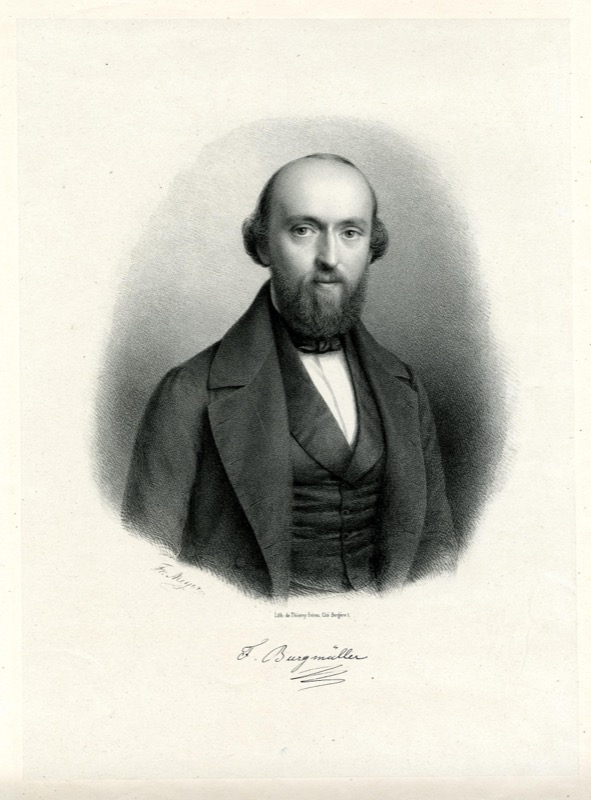
Burgmüller's 25 Études faciles Op. 100, published in Paris around 1838, are the most-taught beginner étude set in piano history. Each piece carries a poetic French title, and each title is a listening target. Le Courant limpide - 'The Clear Current' - is one of the most vividly pictorial: the student is asked to imagine a stream running smoothly and transparently over river stones.
The étude is in G major and 4/4 time, and it is compact - just 16 measures. The right hand carries an almost unbroken stream of eighth notes in scale patterns, while the left hand provides steady harmonic support below. Unlike La Vélocité (No. 6), which is primarily about speed, Le Courant limpide is about legato continuity: the notes must flow without gaps or bumps, the way water follows the contour of a riverbed. One unevenness in the passage and the stream becomes a dripping tap.

Practice path
Imagine water - never a bump, never a gap.
Learn the right-hand passage work hands-separately first, aiming for a completely smooth connection between each note - if any note sounds heavier or louder than its neighbors, stop and isolate that finger. Then add the left hand at 60% tempo: the bass should underpin the stream, not compete with it. The measure count is small enough that hands-together loops of the full piece are practical within a single session.
Score basis: Generated MusicXML from Mutopia MIDI. Public domain composition; Public Domain (CC0) - Mutopia; MusicXML generated for Pianodemy. Attribution: Mutopia Project (https://www.mutopiaproject.org/cgibin/piece-info.cgi?id=216).
MIDI source: Mutopia Project (https://www.mutopiaproject.org/cgibin/piece-info.cgi?id=216). Public Domain (CC0) - Mutopia.
Questions
Before you practice.
Short answers for learners and for searchers deciding whether this is the right version to start with.
01What level is Burgmüller Le Courant limpide?
It sits solidly at the beginner level. The right hand carries a continuous eighth-note line in G major, while the left hand plays a simple blocked or broken accompaniment - accessible after the first few months of study.
02What technique does Le Courant limpide develop?
It trains smooth, even scale passage-work in the right hand and teaches students to keep the melody connected while the left hand provides harmonic support without overpowering.
How to use this V1
Passage work is a physical habit, not a note list.
Use the tempo slider at 50-60% and listen specifically for note five and note six of every eight-note group - these middle fingers tend to drop in volume. A useful trick: play the passage in dotted rhythms (long-short, then short-long) at 70% to expose any uneven finger weighting. Once evenness is reliable at 75% tempo, the stream effect appears automatically.
Keep going