Interactive piano piece
Learn Innocence, Op. 100 No. 5
A gentle waltz-time étude in F major that teaches quiet right-hand melody balanced over a light left-hand accompaniment. The interactive desk loads the full score and lets you loop individual four-bar phrases to work on the dynamic arc - slow the playback to hear exactly how each phrase should breathe before you shape it yourself.
Browser MIDI check pending
Loading score...
Press Play for the full piece, or choose Opening and switch to Wait for note for guided right-hand practice.
About the piece
The quietest étude in Op. 100 - and the hardest to play softly.
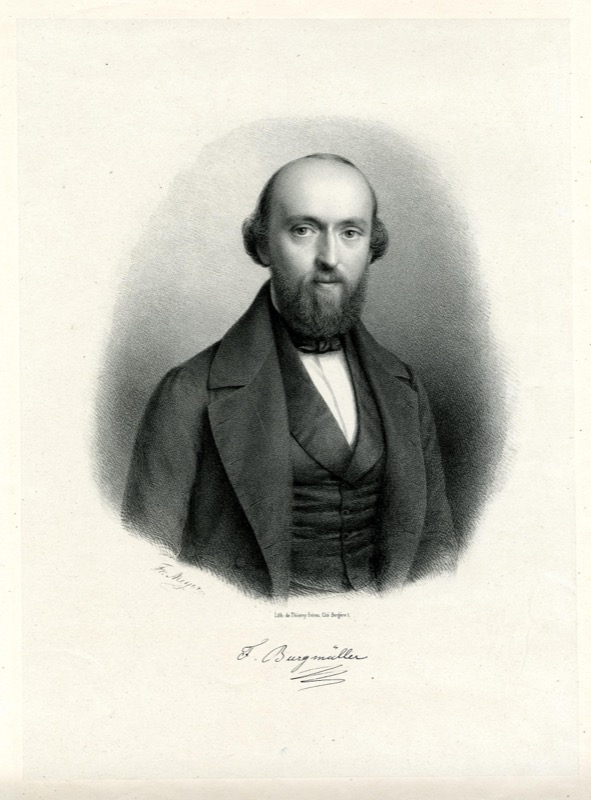
Burgmüller's 25 Études faciles Op. 100, published in Paris around 1838, remain the cornerstone of first-year piano teaching worldwide. Every étude in the set carries a French title that names a quality or scene - and the title is a practice instruction in disguise. Innocence means restraint, gentleness, and the absence of force.
No. 5 is in F major and 3/4 waltz time, and it is technically one of the simpler études in the collection. Its difficulty is entirely expressive: the melody must stay piano throughout, and the left-hand waltz accompaniment must stay even softer. Young students who are only beginning to control their volume will discover here that playing quietly and evenly is far harder than playing loudly. The seventeen-measure étude is a focused lesson in dynamic control at the pianissimo end of the range.

Practice path
Find your quietest usable tone before you start.
Before learning the notes, press a single key - any white key - and find the softest touch that still produces a clear, singing sound (not a dull thud). That is the target tone for the entire étude. Then learn the right-hand melody alone at that volume, shaping each four-bar phrase with a tiny swell to the midpoint and a gentle fade. Only add the left hand once the right-hand tone is consistent and quiet.
Score basis: Generated MusicXML from Mutopia MIDI. Public domain composition; Public Domain (CC0) - Mutopia; MusicXML generated for Pianodemy. Attribution: Mutopia Project (https://www.mutopiaproject.org/cgibin/piece-info.cgi?id=214).
MIDI source: Mutopia Project (https://www.mutopiaproject.org/cgibin/piece-info.cgi?id=214). Public Domain (CC0) - Mutopia.
Questions
Before you practice.
Short answers for learners and for searchers deciding whether this is the right version to start with.
01What does Burgmüller Innocence teach?
It teaches dynamic balance between hands - the melody must sing clearly while the accompaniment stays in the background. It also introduces 3/4 waltz phrasing.
02Is Innocence Op. 100 No. 5 suitable for young beginners?
Yes, it is one of the gentlest pieces in the set. The short phrase length (17 measures) and simple F major key make it accessible in the first or second year of study.
How to use this V1
Quiet is a skill, not a mood.
Set the tempo slider to 70% and practice the left-hand waltz accompaniment alone, ensuring every note is equal and softer than you expect. When you add the melody, keep the left hand subordinate at all times - if the two hands sound equal in volume, the accompaniment is too loud. The étude is only 17 measures; repeated slow loops are the fastest path to genuinely controlled, even softness.
Keep going